There are people who know how to do their work almost perfectly.
They know how to solve a problem, correct a mistake, and bring a result to where it needs to be. Sometimes work is more than an obligation. It becomes a way of existing.
There is nothing wrong with that.
At some point, a professional role can become so familiar that a person no longer notices where the work ends and he begins.
Kazuo Ishiguro captured one possible extreme of this in The Remains of the Day.
Stevens is almost perfect at his profession. He knows how to be a butler. He knows how to serve. He knows how to preserve dignity as the familiar order around him begins to change.
But the further he goes into his memories, the more insistently another question appears.
Who was Stevens outside his role?
And that is perhaps one of the novel’s greatest strengths. Ishiguro does not make him either a villain or a pathetic victim. Stevens does not seem like a man whom life simply passed by. He chose his profession, was good at it, and seems to have been quite content with it for a long time.
Only later does it become clear that a well-lived professional life and a life well lived are not necessarily the same thing.
Perhaps that is why what interested me was not so much Stevens’s story as the possibility of switching between the two.
Do we know how to switch off the person we work as and switch on the person we live as?
Not forever. Sometimes just for a little while.
I have seen this much closer to home.
A former colleague of mine, a tailor, retired. She lived only two more years. Then cancer was discovered.
I do not want to draw conclusions from this story that are not there. Illness cannot be explained by what a person did before it.
But whenever I think of her, one simple word comes to mind: later.
I’ll rest later.
I’ll go later.
I’ll call later.
There will be time later.
It is a convenient word. It allows us to decide nothing today.
Only time does not sign agreements with us.
But perhaps switching off does not always mean drawing a clear line between work and rest.
Sometimes it is more interesting to do the opposite.
On one trip, I was unexpectedly interested in a Chinese boutique. Everything there was remarkably uniform: the clothes, the lighting, the setting, even what the staff were wearing. Everything belonged to the same aesthetic.
Not my thing in business.
But I stayed.
At one point, I even joined them for their short lunch.
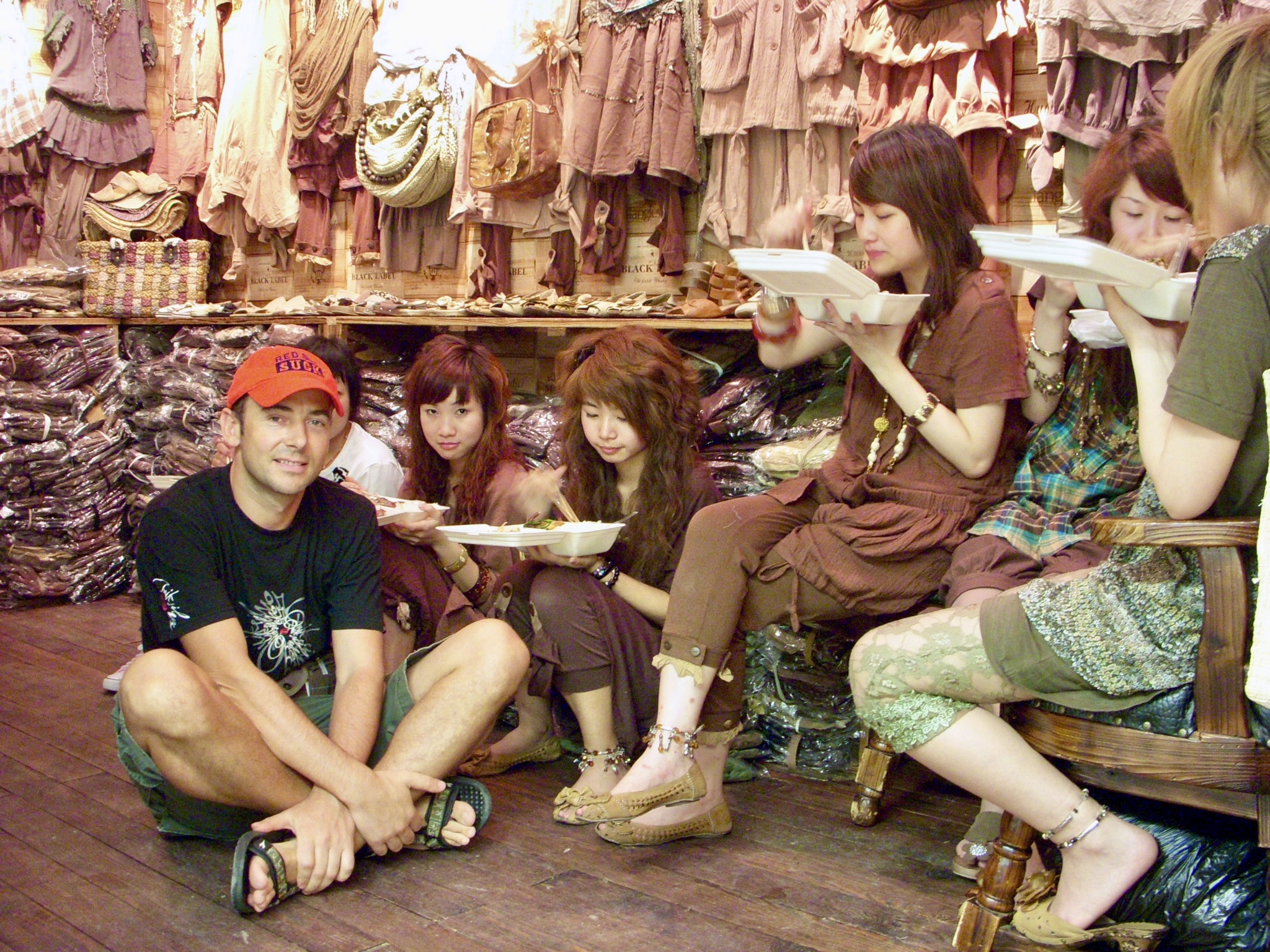
Technically, I was among clothes again. But there was no work for me there. No client, no order, no deadline, no fitting.
There was only curiosity.
There is something in that: curiosity without agenda.
And perhaps rest does not necessarily mean lying down and doing nothing.
Sometimes it means being able to look at a flowering branch without thinking about how to photograph it. To walk down an unfamiliar street without a destination. To talk to someone from whom you need nothing.
To stop being useful for a few minutes.
That, too, is a kind of measure.
Not all of life needs to be occupied by work.
And perhaps we do not have to wait until the end of the day to discover that the day has already ended.
Sometimes it is enough to switch off the craftsman for a while and see who remains.